An idea for a new feature for coverage measurement: per-caller coverage
I’ve had an idea rattling around to get more detail from coverage measurement. Can we measure the coverage in a function separately for each caller of the function?
Here’s why I want it: in Acidica, my toy BASIC interpreter, I had code to implement the built-in functions that looked something like this:
match func_name:

    case "LEN":
        if len(args) != 1:
            raise TypeError(f"Wrong arguments for LEN, got {len(args)}")
        return len(args[0])

    case "LEFT$":
        if len(args) != 2:
            raise TypeError(f"Wrong arguments for LEFT$, got {len(args)}")
        return args[0][:args[1]]

    # ... 19 other built-ins ...
I didn’t like the repeated code here: each different func_name has to
check that it got its expected number of arguments and perhaps raise an error.
So I refactored:
def expects(nargs: int, func_name: str, args: tuple) -> None:
    if len(args) != nargs:
        raise TypeError(f"Wrong arguments for {func_name}, got {len(args)}")

match func_name:
    case "LEN":
        expects(1, func_name, args)
        return len(args[0])

    case "LEFT$":
        expects(2, func_name, args)
        return args[0][:args[1]]
Nice. The code is tighter, easier to read, and common behavior is implemented in one place.
But the old code had an advantage: because each error condition had its own
raise line, coverage measurement could tell me whether I had tested every
func_name for the wrong number of arguments. With the error handling
happening in a helper function, that information is lost. I’ll know that
somefunc_name had a test for the wrong number of arguments, but
not that all of them did.
Here’s where the new idea comes in. What if I could indicate that for the
expects function, I want separate coverage data for each distinct calling
site? Then I could see that every func_name had a test for both the wrong
number of arguments and the right number of arguments. The simple branch inside
expects would be measured separately for each caller.
I have a quick proof-of-concept. A decorator on expects does the work.
Coverage.py already has dynamic contexts which are used for things like tracking
which tests called which code. The decorator starts a new context named for the
calling location, then restores the context when the function returns:
def coverage_per_caller(func):
    @functools.wraps(func)
    def _wrapper(*args, **kwargs):
        cov = coverage.Coverage.current()
        name = func.__name__
        caller = inspect.currentframe().f_back
        file = caller.f_code.co_filename
        lineno = caller.f_lineno
        prev_context = cov.switch_context(f"per_caller:{name}:{file}:{lineno}")
        try:
            ret = func(*args, **kwargs)
        finally:
            cov.switch_context(prev_context)
        return ret

    return _wrapper
I had to make one tiny (unreleased) change to coverage.py for this:
switch_context used to return None, but now it returns the previous
context so that we can nest them properly.
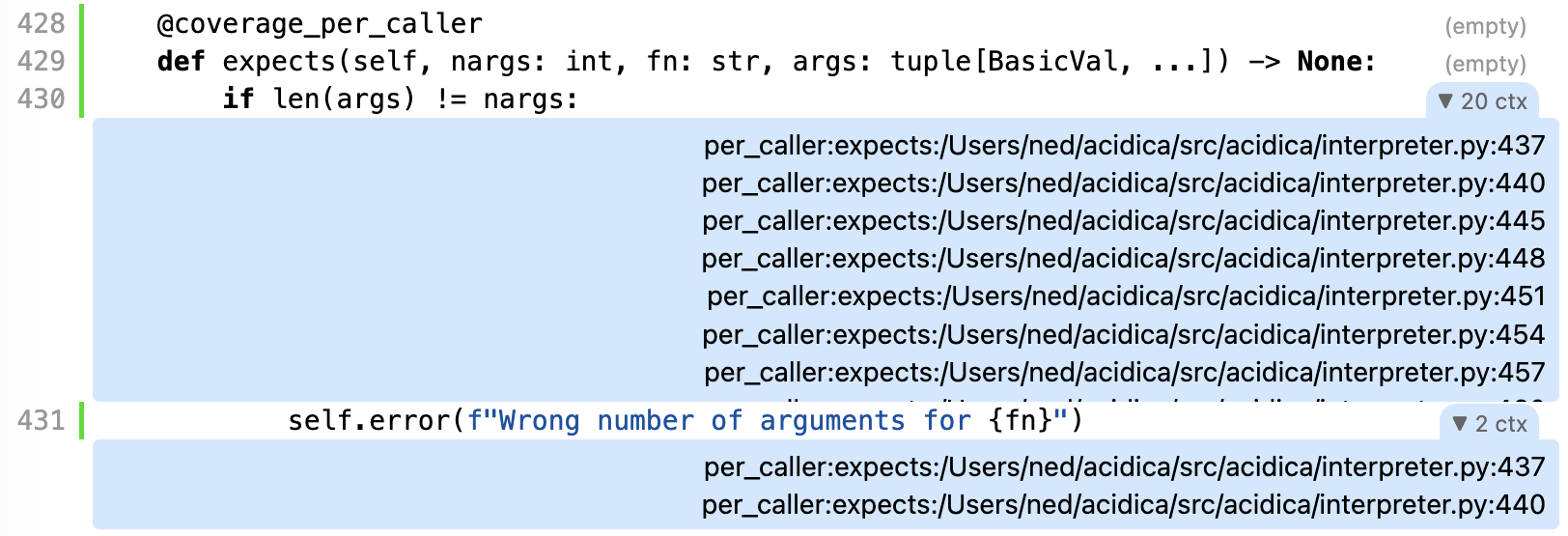
To my delight, this works! I can look at the HTML coverage report and see the
caller contexts for the lines in expects. I can see that 20 callers ran
the if line, but only 2 ran the raise, and the context names show
the file and line number of the callers for each:
This isn’t the whole solution yet. Things to improve:
- I’d like to post-process these contexts to show which callers were missing
lines inside
expects. What I’m looking for is the same kind of “this line is missing” information that I got from the original inlined logic. - These per-caller contexts overwrite the contexts we were already collecting (the test names). Ideally we’d have some kind of sub-context so that we could track both (or many) at once.
- It’s not great that I had to add a decorator to the source code. Driving this through the coverage configuration would keep these kinds of details out of the source.
But it’s a start, and gives me other ideas. I could use some aspect of the
data passed into a function as the context name. In this example, we could have
used func_name as the context instead of the caller’s location. Maybe
you have ideas for other uses.
Comments
Add a comment: